Most law firm link building is painfully easy to copy.
A competitor can buy the same directory listing, sponsor the same generic article, or pay the same broker for a placement. The link may exist, but the firm has created nothing. There is no new reason to remember the brand, no resource a reporter would bookmark, and no advantage that gets stronger with time.
The better question is not, “Where can we place a link?” It is, “What can this firm build that deserves to become a source?”
That is the thinking behind GJEL Accident Attorneys’ San Jose Crash Map and Street Safety Atlas. It turns official 2020–2024 collision records into an interactive explorer, 20 location reports, ranked intersections, downloadable evidence, a methodology, a source register, and clear reuse instructions.
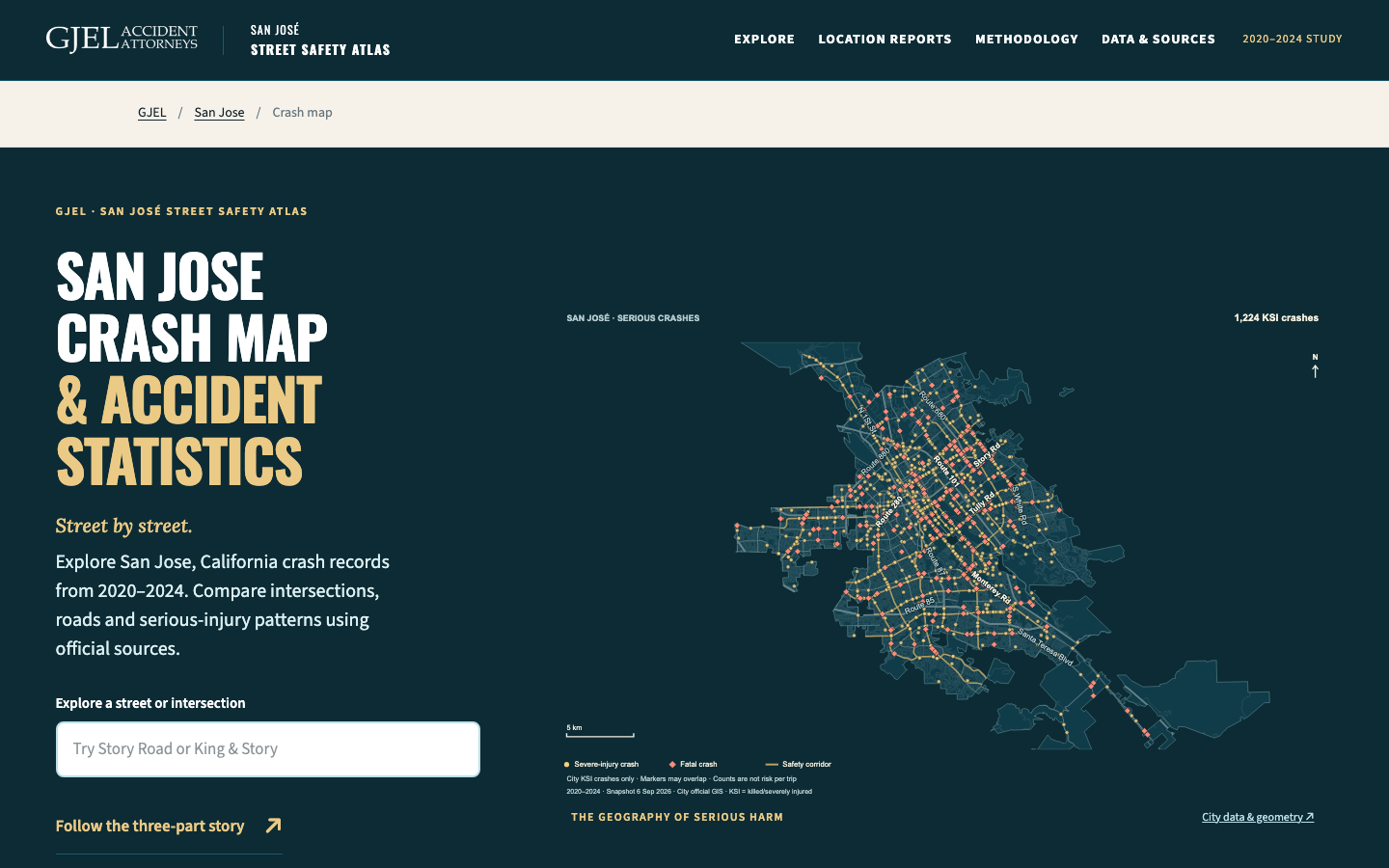
The opening view makes the research tangible immediately: a searchable city map, visible crash patterns, and a clearly defined study period. Screenshot: GJEL Accident Attorneys.
The result is useful before anyone links to it. That is exactly why people have a reason to link to it.
A backlink is a transaction. An asset is infrastructure.
Buying a placement produces one line item: a link on somebody else’s page. A useful asset produces several things at once:
- a destination journalists can cite;
- original findings for outreach and press coverage;
- a reason for community groups to share the firm’s work;
- proof that the firm understands its market;
- material for social posts, newsletters, presentations, and follow-up studies;
- a resource AI search systems can quote and attribute; and
- an owned property that can improve instead of expiring.
The San Jose atlas currently documents 24,133 reported crashes, 1,224 crashes involving a fatality or severe injury, 265 people killed, and 1,056 people severely injured during the study period. It also explains what those numbers mean, where they came from, and where their limits are.
That last part matters. Publishing a dramatic number is content. Publishing the source, definitions, methodology, corrections process, and reusable tables turns the work into evidence.
Seven assets a law firm could build in its own market
The crash map is one expression of the strategy, not a template every firm should copy. The best asset sits at the intersection of public interest, the firm’s knowledge, and information people currently struggle to find.
1. A dangerous-road or intersection atlas
Use official collision data to help residents explore patterns by road, intersection, year, or road-user type. Include definitions and avoid claiming that raw crash totals prove risk without traffic-volume data.
2. A court accessibility scorecard
Document parking, public transport, security procedures, wheelchair access, interpreter information, filing locations, and official contact details for local courts. The useful part is not an opinionated ranking. It is saving a visitor from opening twelve government pages.
3. A local insurance-delay tracker
Collect properly anonymized, aggregate data on the time between a claim, acknowledgement, inspection, offer, and resolution. Publish the sample size and collection method. The project can reveal process friction without disclosing client information.
4. A sentencing or case-outcome explorer
For criminal defense firms, organize public court data by charge, jurisdiction, or disposition. This requires careful legal review and prominent warnings that past cases do not predict an individual result.
5. A neighborhood accessibility audit
An elder-law or disability-rights practice could document curb cuts, crossings, public-building access, or transit gaps. Pair observations with a transparent rubric and a way for residents to submit corrections.
6. A plain-English deadline calculator
Build a narrowly scoped educational tool that points readers to the controlling official source and clearly identifies exceptions. Do not disguise a lead form as a calculator. Let the visitor get the answer without surrendering personal information.
7. A public-record request kit
Create jurisdiction-specific instructions, agency links, request templates, expected fees, and escalation paths for obtaining police reports, body-camera footage, property records, or administrative decisions.
The “would this survive without Google?” test
Before approving an asset, ask whether a real person would use it if search engines did not exist.
Would a reporter use the table while covering a local story? Would a neighborhood association send the map to its members? Would a librarian bookmark the guide? Would another lawyer forward the tool to a client they could not represent?
If the only imagined user is a link-building prospect, the idea is probably just another campaign wearing a nicer coat.
How to build the asset so people trust it
Start with a narrow question. “Everything about road safety” is not a scope. “Which San Jose intersections recorded the most fatal or severe-injury crashes from 2020 through 2024?” is.
Then make the evidence inspectable:
- Name every original source.
- Define the terms that affect the conclusions.
- Explain exclusions, matching rules, and known gaps.
- Publish the data or tables you have permission to redistribute.
- Give the study a version and snapshot date.
- Provide a correction channel.
- Create a press-and-reuse page with ready-to-use attribution.
This work is slower than ordering 20 links. It also produces something 20 bought links never will: an identifiable piece of the web associated with the firm.
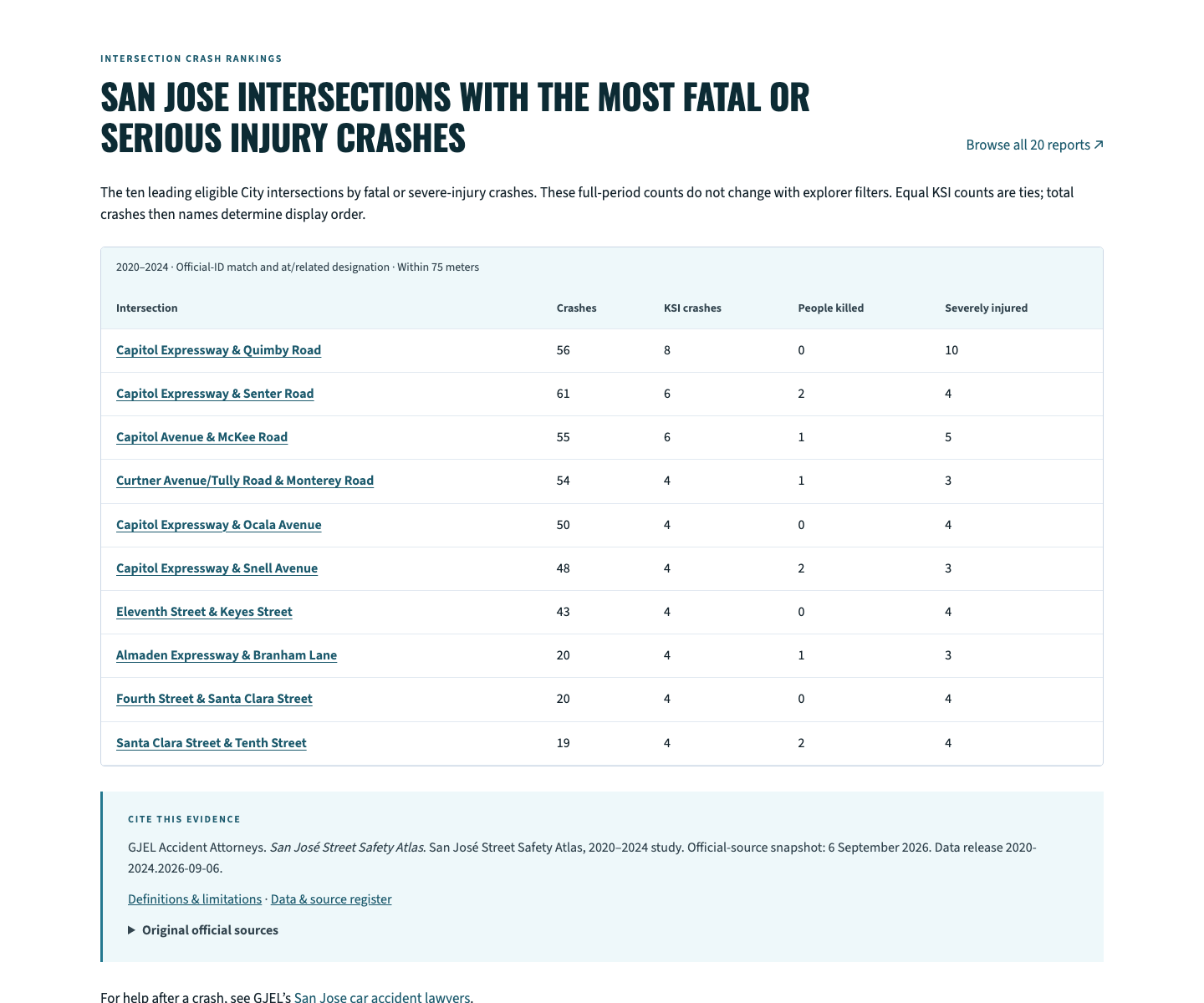
The rankings are paired with definitions, source links, and ready-to-use citation language. That evidence layer is what turns an attractive page into a credible source. Screenshot: GJEL Accident Attorneys.
Outreach becomes service, not begging
Traditional outreach often asks a publisher to help the law firm. Asset-led outreach helps the publisher do their job.
The email changes from “Would you add our link?” to “We analyzed five years of official local crash records, found three patterns relevant to your transportation beat, and made the underlying tables and methodology available here.”
That is a better pitch because it contains a story, evidence, and a usable source. The link is attribution, not the entire point of the exchange.
What the firm owns at the end
The strongest part of this strategy is not any single backlink. It is the collection of assets the firm keeps:
- the cleaned dataset;
- the research method;
- the interactive tool;
- the brand association with the topic;
- the reporter and community relationships;
- the citations and mentions; and
- the ability to publish the next edition faster.
Everyone can buy a link. Very few firms will do the work required to become the source behind the link.
That scarcity is the opportunity.
Topics
Related Articles
GEO vs SEO: Preparing Your Law Firm for AI-Powered Search
As AI chatbots reshape how people find lawyers, Generative Engine Optimization (GEO) is becoming essential. Here's how law firms should adapt.
Read MoreThe 'Don't Pay Until You Rank' Trap: Why Performance SEO Fails Law Firms That Want to Win
Pay-for-performance SEO sounds risk-free. But when Google changes its algorithm, these agencies have no income to fix your rankings. Here's what actually happens.
Read MoreWhy Law Firms Need a Specialized SEO Expert in 2026
Discover why generic SEO agencies fail law firms and how a specialized law firm SEO expert can deliver significant results for your practice.
Read MoreNeed Help With Your Law Firm's Marketing?
With 15+ years of experience helping law firms grow through SEO and digital marketing, I can help you develop a strategy that delivers results.